| Ingredient | Quantity(grams) |
|---|---|
| Beef | 400 |
| Pork leg | 400 |
| Pork belly | 200 |
| Sugar | 50 |
| Salt | 20 |
| Instacure#2 | 2.4 |
| Powdered garlic | 2 |
| Black peppercorns | 2 |
| Ground white pepper | 2 |
| Fennel seed | 1 |
| Clove | 0.5 |
| Starter culture(bacteria) | 0.2 |
| Collagen casing 60 mm | 0.1 |
Any question about how to make this recipe? Please, leave a comment with your question.
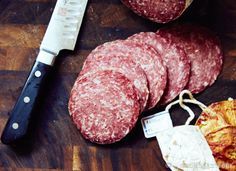
Preparation > Hamburgues salami
1) Grind the meat into 8mm;
2) Grind the fat into 4mm;
3) Mix all the ingredients, meat and fat until sticky;
4) Place in 60 gauge collagen casing;
5) Leave 7 hours at room temperature to ferment;
6) Hang in a cold, humid and ventilated environment until the salami loses 40% of its weight;
note; The ideal ambient temperature and humidity for hanging salami is 12ºC and 70% to 80% humidity.
Charcuterie Guide Dicas de como fazer linguiça em casa
Sal de cura, o que é e quanto usar?
Diferenças entre tripas naturais, colágeno e artificiais
Comprar tripa
Comprar sal de cura
Salame fácil para fazer em casa
Interações 3

Carlos Alberto
28/03/2026 22:56
Para quem está começando, um defumador caseiro simples é suficiente ou recomenda algo com controle mais preciso?
Responder

C. Alberto
A caixa de papelão com serragem fria funciona muito bem.

Clube da Charcutaria
28/03/2026 12:56
O tempo de cura de um salame artesanal pode variar de 30 a 90 dias, dependendo do calibre da tripa e das condições de umidade e temperatura.
Responder